


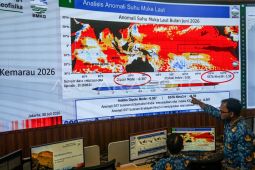
Jakarta (ANTARA) – The Meteorology, Climatology, and Geophysics Agency (BMKG) forecasts that the 2026 dry season will be less severe than the one experienced during the 1997 El Niño, despite the current event having reached a strong phase.
BMKG’s Acting Deputy for Climatology and Director of Climate Change, Fachri Radjab, informed that based on a comparative analysis of monthly rainfall probability conditions, the 2026 dry season is generally not expected to be drier than the 1997 El Niño period.
However, the BMKG noted that several regions, such as Kalimantan, Papua, and Java, have the potential to experience drier conditions in September-November 2026 than in 1997.
From September to November 2026, several regions will have a fairly high probability of being drier, including most of Kalimantan and Papua with an 80-90 percent probability, several areas on Java in October, and several other areas in November.
The agency predicts the peak of the 2026 dry season will occur between August and September, with around 54 percent of Indonesia’s territory expected to experience the peak of the dry season in August, while some other regions will experience it in September.
In addition to comparing it to the 1997 El Niño, Radjab said the BMKG is also examining the characteristics of the 2026 El Niño compared to previous events.
Based on comparisons with three El Niño phenomena in the last 15 years: 2015, 2019, and 2023, the 2026 dry season is expected to be closer to the 2023 El Niño pattern.
Radjab reminded that although the 2026 dry season is not expected to be as severe as during the 1997 El Niño, the government should remain vigilant against its potential impacts, including a heightened risk of forest and land fires.
According to him, as land conditions become drier, the potential for hotspots to emerge also increases.
BMKG monitoring as of August 2 found approximately 5,690 hotspots across several regions in Indonesia.
Earlier, the agency said that the 2026 El Niño had entered the strong category and still had the potential to become very strong.
The impact of this phenomenon will be primarily felt in areas south of the equator, such as East Nusa Tenggara, West Nusa Tenggara, Bali, Java, southern Sumatra, and southern Papua.
To anticipate the impact of El Niño, the BMKG continues to strengthen mitigation measures, including through the weather modification operations (OMC) to maintain water availability and reduce the risk of drought.
The operation is being carried out in coordination with relevant ministries and agencies to increase water supplies in reservoirs that support raw water needs, agriculture, and hydroelectric power generation.
Related news: Indonesia gears up as stronger El Nio looms: BMKG
Related news: Indonesia sets four priority response clusters to address El Nio
Related news: Indonesia tackles 294 drought hotspots to protect food security
Translator: Shofi Ayudiana, Resinta Sulistiyandari
Editor: Azis Kurmala
Copyright © ANTARA 2026