


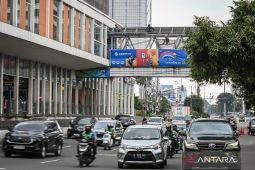
Jakarta (ANTARA) – Researcher Caecilia Suprapti Dwi Takariani at the National Research and Innovation Agency’s (BRIN) Public Policy Research Center designed an integrated mobility model for accessible, safe, comfortable, and independent public transport services for people with disabilities.
Through research in five big cities, which are Jakarta, Bandung, Surakarta, Yogyakarta, and Surabaya, BRIN mapped user needs across seven travel stages, from considering departure to arriving at the final destination.
“Integration must be understood as system coherence, not merely the existence of several transport modes,” Takariani said in an online discussion followed from here on Thursday.
She detailed that the model adopts a Mobility as a Service (MaaS) approach combining three main aspects, which are the physical aspect (infrastructure and modes), the operational aspect (schedules, fares, and information technology), and the institutional aspect (regulation and governance).
The approach also carries the design for all principles, so transport facilities not only accommodate people with disabilities but also benefit other vulnerable groups such as the elderly, pregnant women, and children.
Takariani added that the model is still at the conceptual stage, so it needs field testing and phased implementation with operators and regional governments to test its effectiveness.
According to her, public transport accessibility for people with disabilities in Indonesia is still inadequate due to five main barriers, which are physical, trip integration, service availability, socioeconomic, and information technology barriers.
Meanwhile, Transportation Ministry Sustainable Transportation Management Center Head Dini Kusumahati Damarintan praised the model framework BRIN designed and said the Ministry will adopt the approach to strengthen cross-mode policy.
She mentioned that the travel chains of people with disabilities are often broken at access to bus stops or stations, such as blocked guiding paths for the blind and sidewalks without ramps, so the ministry requires new transport nodes and renovations to pass accessibility feasibility tests.
Through evidence-based research collaboration from BRIN and stronger operational regulation from the ministry, Damarintan expressed hope that the national mass transport ecosystem can be fully connected door to door without leaving any group behind.
Related news: Govt seeks to raise formal employment for disabled people to 12 pct
Related news: Jakarta provides 37 dedicated school buses for disabled students
Related news: President Prabowo calls for stronger support for disabled athletes
Translator: Sean, Kenzu
Editor: Azis Kurmala
Copyright © ANTARA 2026