


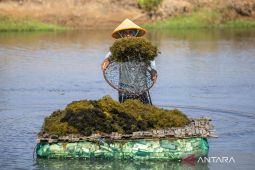
Jakarta (ANTARA) – Indonesia’s National Research and Innovation Agency (BRIN) has mapped the seaweed industry’s value chain from upstream to downstream to identify untapped opportunities and maximize the sector’s potential.
PRSIMB researcher Ari Kabul Paminto said in Jakarta on Thursday that value-chain mapping was needed to determine the position of each industrial stage and identify opportunities for further economic value creation.
“We must transform from a resource-based economy that only exploits raw materials into a capability-based economy relying on technology and high-value innovation. Natural resources should be inputs, not final products,” Ari said.
As part of the mapping, BRIN traced the industrial process from raw materials and processing to intermediate products, downstream derivatives, and their various applications.
The approach was used to assess which parts of the value chain have developed, while identifying stages that still have potential to generate additional economic value.
PRSIMB Head Nugroho Adi Sasongko said the mapping was needed to determine how much economic value seaweed had generated at each processing stage.
“We want to see how far marine products, particularly seaweed, have progressed. Are they still dried biomass or have they become derivative products, and how much added value do they generate?” Nugroho said.
Besides tracing product flows and added value at each stage, the study examined opportunities to use raw materials more comprehensively through a biorefinery cascading approach.
The approach allows a single raw material to be used in stages to produce several types of products, potentially increasing the value extracted from the same material.
In response to the approach, Pontas Tambunan, deputy chairman of the Indonesian Seaweed Industry Association (Astruli), said it could be used to maximize seaweed utilization across the value chain.
“Seaweed extraction should no longer leave waste without value. Through cascading, seaweed is extracted in stages so its economic value can be utilized more fully,” Pontas said.
Indonesia currently has 57 seaweed processing industries with a total installed capacity of 197,650 metric tons of dry raw materials a year. About 80 percent of carrageenan products remain in semi-refined or ATC form.
The data illustrate room to develop products further downstream. Potential seaweed derivatives include carrageenan, agar, alginate, functional foods, pharmaceuticals, cosmetics, bioplastics, and biostimulants.
Under the approach, seaweed can also be processed into products such as biostimulants, nutrients, agar, and carrageenan, while residual materials can be directed to energy products such as biogas and Refuse Derived Fuel (RDF).
Related news: UNDP highlights seaweed processing to strengthen Indonesia economy
Related news: Australian biotech company partners with Indonesia on seaweed supply
Related news: Indonesia gains US market edge as seaweed tariff drops to zero
Translator: Sean FM, Rahmad Nasution
Editor: Azis Kurmala
Copyright © ANTARA 2026