


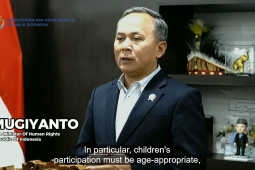
Jakarta (ANTARA) – Indonesia’s Deputy Minister of Human Rights Mugiyanto is pushing to strengthen human rights due diligence (HRDD) obligations for businesses through the development of regulations that integrate respect for human rights into corporate governance and operations.
The initiative is being pursued through the drafting of a Presidential Regulation on Business and Human Rights Compliance Assessments for Business Entities, as part of Indonesia’s efforts to shift from a voluntary approach toward more structured mandatory human rights due diligence requirements.
“What matters most is whether businesses are able to identify risks, prevent or mitigate impacts, assess the effectiveness of their measures, communicate transparently, and address adverse impacts when they occur,” Mugiyanto said in a statement issued in Jakarta on Thursday.
He made the remarks in a recorded video keynote address at the 15th United Nations (UN) Forum on Business and Human Rights in Geneva, Switzerland, on Tuesday (Nov. 24).
According to Mugiyanto, respecting human rights in business operations cannot be achieved solely through corporate social responsibility (CSR) programs or compliance with administrative requirements. Instead, human rights principles must be embedded in business processes and corporate decision-making.
Human rights due diligence comprises six key elements: a human rights policy commitment; identifying and assessing actual and potential impacts; preventing and mitigating adverse impacts; monitoring and evaluating performance; transparent communication and reporting; and ensuring victims have access to remedy.
Mugiyanto explained that the transition toward mandatory human rights due diligence would not mean abandoning voluntary initiatives already undertaken by businesses. Rather, it aims to strengthen such initiatives through clearer standards and more robust implementation and accountability mechanisms.
The approach is also designed to ensure that stronger human rights obligations do not undermine the investment climate or business competitiveness. Indonesia is adopting a policy mix that combines regulation with voluntary initiatives, incentives, recognition mechanisms, technical assistance and capacity-building programs for businesses.
Particular attention is being given to micro, small and medium enterprises (MSMEs) and suppliers within global value chains. Human rights due diligence requirements need to be tailored to the size and capacity of businesses to ensure that compliance costs are not unfairly imposed on smaller companies.
Large corporations are also expected to help strengthen their suppliers’ capacities and ensure that human rights-respecting business practices are implemented throughout their supply chains.
“The success of this policy must be measured by its impact on people,” Mugiyanto said.
He stressed that the effectiveness of human rights due diligence should not be measured solely by the number of reports submitted by companies. Meaningful participation by workers, local communities, women, children and other affected groups must also be ensured.
To that end, safe and accessible grievance mechanisms are needed to protect complainants from retaliation. Indonesia is also developing a National Contact Point (NCP) as part of its commitment to acceding to the Organisation for Economic Co-operation and Development (OECD), with the aim of strengthening responsible business conduct and access to remedy.
Addressing the forum, which focused on advancing the implementation of the UN Guiding Principles on Business and Human Rights (UNGPs), Mugiyanto outlined three priorities for the Asia-Pacific region: strengthening the implementation of national action plans, developing effective human rights due diligence frameworks, and placing rights-holders at the center of policy through meaningful participation and access to remedy.
“Economic growth, investment and competitiveness will be sustainable when they go hand in hand with human rights. Respect for human rights builds trust and helps create more inclusive and resilient businesses and economies,” he said.
The 15th UN Forum on Business and Human Rights is being held from November 23 to 25, 2026, at the Palais des Nations in Geneva, Switzerland.
The Indonesian delegation is participating in person, with representatives from the Ministry of Human Rights, the Ministry of Foreign Affairs and the Permanent Mission of the Republic of Indonesia in Geneva.
Related news: Indonesia’s Komnas HAM urges human rights-based fire management
Related news: Indonesia eyes tougher penalties for rights, environmental violations
Translator: Devi, Azis Kurmala
Editor: Martha Herlinawati Simanjuntak
Copyright © ANTARA 2026