


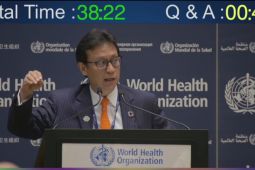
Jakarta (ANTARA) – Indonesian Health Minister Budi Gunadi Sadikin said he would prioritize health technologies, including artificial intelligence (AI), genomics and data governance, while refocusing the World Health Organization (WHO) on equity and affordability if elected its director-general.
Speaking at a forum for candidates for the WHO director-general position, broadcast in Jakarta on Thursday (November 19), Budi outlined a three-pillar vision aimed at expanding access to healthcare worldwide. The first pillar focuses on restoring the agency’s core role of setting science-based norms and standards.
As part of this effort, he pledged to promote AI, robotics, genomics and precision medicine, supported by robust data governance and safety standards. He also proposed reviewing more than 3,000 existing WHO resolutions with member states to prioritize their implementation.
Budi’s second pillar centers on using the WHO to mobilize global support in line with the specific health priorities of individual countries.
“Health sovereignty must be at the heart of global health collaboration and the global health architecture. But sovereignty does not mean isolation; it means solidarity and equity,” he said.
According to Budi, the WHO can help countries develop credible national health plans, mobilize partners to support them, and coordinate resources to improve transparency and productivity while expanding public access to more affordable healthcare services.
He cited Indonesia’s efforts to mobilize US$8.7 billion over five years for national health priorities, as well as the establishment of a pandemic fund during Indonesia’s G20 presidency through collaboration between health and finance leaders, as examples of the country’s convening power.
“At the global level, during Indonesia’s G20 presidency, I worked with finance ministers to bring together leaders from the health and finance sectors, ultimately reaching an agreement to establish a pandemic fund,” Budi said.
He also highlighted Indonesia’s roles on the boards of the Global Fund, Gavi, the Coalition for Epidemic Preparedness Innovations (CEPI), and the Stop TB Partnership, reflecting his belief that collaboration can achieve greater results.
For his third pillar – strengthening the WHO internally – Budi drew on his background running a major bank with 100,000 employees and US$65 billion in assets, as well as Indonesia’s health ministry, which has more than 70,000 staff and a US$7 billion annual budget.
He stressed hiring based on competence and integrity, noting that women hold half of leadership positions at the Indonesian Ministry of Health and pledging to promote equal opportunities for women at all levels within the WHO.
On financing, Budi said he would back current WHO Director General Tedros Adhanom Ghebreyesus’ push to source 50 percent of the agency’s budget from member states’ assessed contributions by 2031 while broadening its donor base.
“Regarding financial sustainability, I will continue Dr. Tedros’ excellent initiative to reach a target where 50 percent of the budget comes from member states’ assessed contributions by 2031. I also intend to broaden the WHO’s funding base, align the budget with key priorities and increase transparency in the use of resources,” he said.
Budi closed with a personal account of his mother, who survived a stroke at a hospital without a CT scanner and lived with a disability for 15 years before passing away.
“I often wonder how different her life might have been had she received the right care at the right time. Years later, as Health Minister, I finally had the opportunity and the capacity to take action,” he said.
“I cannot change what happened to my mother, but I can work to ensure a different future for other families. This is what drives me to serve the 280 million people of Indonesia, and it fuels my determination to serve the 8 billion people of the world through the WHO,” Budi concluded, urging health systems to focus on prevention rather than waiting for illness.
Related news: Indonesia nominates Health Minister for WHO Director-General
Related news: Indonesia develops nine ACT programs to expand healthcare access
Translator: Mecca Yumna Ning Prisie, Yashinta Difa
Editor: Primayanti
Copyright © ANTARA 2026