


Jakarta (ANTARA) – Joint firefighting teams across six priority Indonesian provinces have contained more than 80 percent of active forest and land fires, leaving 96.07 hectares remaining as of Monday (September 28), according to the National Disaster Management Agency (BNPB).
Head of the BNPB Center for Disaster Data, Information and Communication Berton Panjaitan stated that out of a total recorded burned area of 527.60 hectares, emergency responders have successfully suppressed 431.53 hectares.
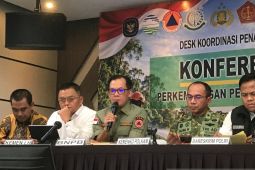
Speaking at a press conference in Jakarta on Tuesday, he noted that firefighting operations covered 369.03 hectares via ground operations and 62.50 hectares via aerial operations.
The progress represents a single-day reduction of 62.29 hectares compared to figures reported on September 27, driven largely by intense suppression efforts in Central Kalimantan, which accounted for a 46.70-hectare drop in active blazes.
“Central Kalimantan is indeed our focus this week,” Berton said, noting that weekly monitoring in the province recorded 335 hectares of burned land, with 255 hectares contained as of September 25.
While emergency operations continue across South Kalimantan, West Kalimantan, and South Sumatra, the situation in Riau remains relatively stable due to substantial natural rainfall combined with targeted weather modification operations.
Despite the overall national decline, small increases were recorded in South Sumatra (up 4.15 hectares) and Riau (up 0.50 hectares) compared to the previous day.
“We are striving to reduce this figure—even down to zero—so that there is no longer a gap regarding those ‘red’ areas,” Berton emphasized.
To accelerate ground response, BNPB has called on regency and municipal governments across the six provinces to establish local task forces consisting of at least 15 equipped personnel.
For aerial containment, BNPB and the Indonesian National Armed Forces (TNI) have deployed 56 aircraft and helicopters, comprising 43 water-bombing units and 13 assets designated for patrols and cloud-seeding.
Berton noted that flight operations remain strictly subject to weather patterns and atmospheric conditions.
“Water-bombing relies heavily on visibility, while weather modification operations depend on visibility as well as atmospheric conditions and the presence of cloud seeds or rain-producing elements in the sky,” he explained.
By strategically maneuvering aerial assets away from zero-visibility zones to operable regions, authorities aim to ensure continuous suppression and eliminate all remaining hotspots.
Related news: Indonesia records decline in forest and land fire hotspots
Related news: Ground crews most effective in battling fires: Prabowo
Related news: Gov’t continues forest fire mitigation, improve peatland management
Translator: Devi Nindy Sari Ramadhan, Yashinta Difa
Editor: Azis Kurmala
Copyright © ANTARA 2026