


Jakarta (ANTARA) – The Indonesian Ministry of Transmigration has partnered with Germany’s Technical University of Munich (TUM) and Central Java’s Diponegoro University (Undip) to design a green growth-based development model for the Batam–Rempang–Galang (Barelang) Transmigration Area.
This collaboration is part of the 2026 Summer Course titled “Transformative Transmigration Planning Towards Green Barelang,” held from October 1 to 10.
The program focuses on spatial planning for the Tanjung Banon transmigration area in Batam, Riau Islands.
“I think transmigration can be a good opportunity for the community if several aspects, such as ecological, economic, and social factors, are integrated in the right way,” Jacob, a TUM delegate, said in a statement released on Monday.
The program aims to formulate an area management strategy that is eco-friendly, self-sufficient, and sustainable by integrating spatial planning, economic growth, environmental safeguards, and community empowerment.
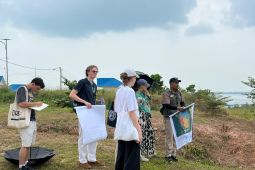
On the third day of the initiative, a multidisciplinary delegation with backgrounds spanning geography, land management, and environmental engineering conducted field observations in the Rempang Eco City area.
Participants gathered data and local feedback to build development models across four key focus areas: spatial planning and economics, land management, coastal environmental sustainability, and community empowerment.
Another TUM delegate, Alina, noted that the field activities provided participants with a unique opportunity to learn directly about Indonesian life while fostering cross-border knowledge exchange.
“Perhaps in the future, there could be a reciprocal exchange to Germany, allowing our two countries to connect further, create things together, and learn from one another,” she said.
Local involvement remains a core pillar of the initiative. Garim, a resident of Rempang Eco City, said the presence of international researchers provided locals with a platform to share their experiences regarding their living environment.
“We are proud because, even though we are from a remote area, we can share our knowledge with people from abroad,” Garim said.
As of May 2026, 242 households comprising 842 individuals had relocated to the new residential zone in Rempang Eco City.
The Batam Authority (BP Batam) confirmed that the relocation is part of the implementation of the local transmigration framework in Rempang.
The Transmigration Ministry previously noted on October 3 that four Patriot Expedition Teams (TEP) from the Bandung Institute of Technology (ITB), IPB University, the University of Indonesia (UI), and the Sepuluh Nopember Institute of Technology (ITS) had conducted preliminary field studies in Barelang.
Their research evaluated seaweed business expansion, urban farming, local commodity value chains, and an integrated survey of Tanjung Banon—providing a foundational knowledge base for course participants as they draft local concepts.
Transmigration Minister Muhammad Iftitah Sulaiman Suryanagara emphasized that the program’s new direction moves beyond mere population relocation toward building sustainable economic hubs.
“We are no longer just moving people to occupy land. We are building an economic ecosystem where people can work, thrive, and achieve prosperity,” Suryanagara stated.
This strategic shift aligns with government policy to revitalize 45 transmigration areas under the 2025–2029 National Medium-Term Development Plan to drive regional economic growth and reduce inter-regional disparity.
The partnership between the Transmigration Ministry, Undip, and TUM is expected to deepen academic cooperation while producing actionable development models that yield tangible public benefits.
Translator: Aria Ananda, Uyu Liman
Editor: Aditya Eko Sigit Wicaksono
Copyright © ANTARA 2026