


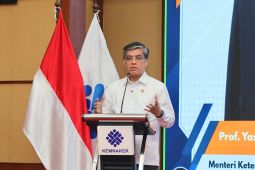
Jakarta (ANTARA) – Indonesia’s Minister of Manpower Yassierli said his department is pushing to shift vocational training from a supply-driven to a demand-driven approach to bridge the skills gap.
Speaking at Indonesia’s Green Jobs Conference 2026 in Jakarta on Wednesday, Yassierli pointed to a paradox in Indonesia’s job market, where youth unemployment (ages 15–24) reached 17.4 percent, while 48 percent of companies reported difficulty finding workers with the required skills.
He cited the World Economic Forum’s (WEF) 2025 Future of Jobs Report, revealed 54 percent of companies in Indonesia identify the skills gap as a major obstacle to their business.
Addressing the issue is an urgent challenge, Yassierli noted, emphasising Indonesia must focus not only on job creation but also on ensuring decent work.
Related news: Indonesia to expand vocational training with 19 new centers in 2027
According to him, closer alignment is needed between education and training programmes and industry demands to ensure the workforce meets market needs.
As part of the demand-driven approach, he cited the establishment of an aerospace training center in Bandung, which is tailored specifically to the needs of state aircraft maker PT Dirgantara Indonesia (PTDI), where labor demand is projected at 500 to 1,000 workers.
Clear labor demand projections from industry, he noted, allow the government to design appropriately targeted training programmes.
“If the demand is clear, we will support it. The Ministry of Manpower will cover the training costs,” Yassierli added.
Related news: Indonesia bolsters comprehensive protections for migrant fishers
He also emphasised the approach ensures vocational training goes beyond merely producing graduates to equipping workers, with the exact skills required by business and industry.
The Statistics Indonesia (BPS) recorded working-age population reached 220.23 million, according to the May 2026 National Labor Force Survey (Sakernas). Of that total, 155.41 million people were part of the labor force.
Within the labor force, 148.19 million people were employed, while 7.22 million remained unemployed.
Related news: 29th ALMM, RI amplifies skill development, worker protection
The labor market structure continues to be dominated by informal jobs, with informal workers making up 56.54 percent of the workforce, compared to 38.81 percent in the formal sector. The national unemployment rate stood at 4.65 percent.
Based on their educational attainment, the majority of the workforce holds an elementary or junior high school education, accounting for 50.52 percent.
Senior high school and vocational high school graduates comprised 32.27 percent, while university graduates accounted for 12.56 percent.
Meanwhile, data from the August 2025 Sakernas showed 76.5 percent of university graduates hold jobs in the formal sector. Conversely, elementary and junior high school graduates dominate the informal sector at 72.5 percent.
Related news: Indonesia targets job readiness for 100,000 people with disabilities
Translator: Shofi Ayudiana, Raka Adji
Editor: Fransiska Ninditya
Copyright © ANTARA 2026