


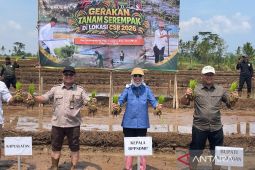
Kuningan, Jawa Barat (ANTARA) – The Ministry of Agriculture’s Agency for Agricultural Extension and Human Resources Development (BPPSDMP) is targeting a simultaneous rice planting movement covering 3,000 hectares nationwide to accelerate the addition of planted areas during the 2026 rainy season.
BPPSDMP Head Idha Widi Arsanti said in Kuningan, West Java, on Saturday that the activity is centered in Kuningan and carried out simultaneously across 14 provinces.
“The simultaneous planting today from across Indonesia is centered in Kuningan District, West Java Province, and we are also carrying out this activity simultaneously in 14 provinces,” Arsanti said.
She stated that the national additional planting area (LTT) target is around two million hectares, while realization remains below 10 percent, necessitating accelerated planting as the rainy season begins.
Arsanti noted that water availability at the start of the rainy season provides an opportunity to speed up planting through collaboration among farmers, extension workers, and field teams.
BPPSDMP selected Kuningan because the area features optimized land, newly developed rice fields, and an established Food Brigade unit supporting accelerated planting.
Arsanti said the land prepared for planting in Kuningan reaches 20 hectares, while the national target for the one-day movement is 3,000 hectares.
She explained that the accelerated planting aims to optimize community-created rice fields completed through the Food Brigade.
Implementation must adjust to regional landscapes and agroecosystems, Arsanti added.
“Adjustments related to the agricultural machinery used will also be made, of course, by looking at the existing agroecosystem conditions,” she said.
She noted that operating agricultural machinery is easier on flat, open terrain than in hilly or sloping areas like parts of Kuningan.
Beyond accelerating planting, the movement aims to space out harvest times to ensure even rice production throughout the year.
Arsanti explained that staggering the planting pattern prevents production spikes, ensuring harvests do not pile up in specific periods.
“We are avoiding situations where a peak harvest occurs, which would push prices down, or a lean season, which would push prices up,” she said.
BPPSDMP previously anticipated potential drought by analyzing data from the Meteorology, Climatology, and Geophysics Agency (BMKG) and coordinating with stakeholders.
“For example, we study the data submitted by BMKG, and we have already made anticipations,” Arsanti said.
Related news: El Niño could delay Indonesia’s rice harvest, raising Eid supply risk
Related news: Ministry steps up efforts expanding planted areas through March 2027
Translator: Fathnur R, Fauzul Azhim Bin Fakhrurazi
Editor: Arie Novarina
Copyright © ANTARA 2026