


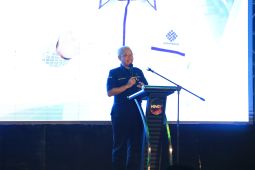
Jakarta (ANTARA) – The Ministry of Manpower is committed to strengthening protection and improving the skills and competencies of workers in Indonesia’s music industry.
“Indonesian music will grow stronger when its progress goes hand in hand with the welfare of the people who make a living from it,” the ministry’s Secretary General, Cris Kuntadi, said in a statement on Monday.
Kuntadi said music workers are part of the national labor ecosystem and are entitled to employment opportunities and a decent livelihood.
This is in line with Article 27, paragraph (2), of the 1945 Constitution, which guarantees every citizen the right to work and to earn a livelihood worthy of human dignity.
“There are two things to understand, first, every citizen has the right to work, and second, to a decent livelihood,” he said.
To support these rights, the ministry is facilitating vocational training and professional certification for 100 members of the Indonesian Association of Singers, Songwriters, and Musicians (PAPRI). The initiative aims to improve their competencies and strengthen professional recognition for Indonesian music workers.
To further standardize competencies, the ministry is also paving the way for the development of Indonesian National Work Competency Standards (SKKNI) tailored to the needs and characteristics of jobs in the music industry.
The development of these standards is expected to support more specific and relevant certification schemes.
Currently, 11 certification schemes are available and can be further developed to meet the competency requirements of music workers.
Kuntadi stressed that professional certification was not intended to restrict music workers’ opportunities, but rather to recognize the competencies they possess.
“Through certification issued by the National Professional Certification Agency (BNSP), music workers are expected to obtain proof of their competencies, which can strengthen their professional recognition,” he said.
In addition to improving competencies, the ministry is also focusing on worker protection, which needs to take into account the specific characteristics of employment in the music industry.
Such protection includes clarity in employment relationships, broader access to employment-related social security, work accident insurance, death benefits, and occupational safety and health measures.
Kuntadi expressed hope that efforts to strengthen and standardize the competencies of Indonesian music workers would improve their protection, ensure that their rights are fulfilled, promote fair employment standards, and expand access to professional certification.
Related news: Indonesian musicians encouraged to be more competitive
Related news: Indonesia’s entertainment boom fueled by data and digital payments
Translator: Arnidhya, Kenzu
Editor: Primayanti
Copyright © ANTARA 2026