


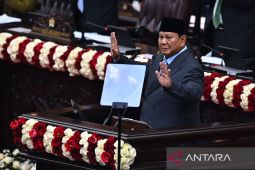
Jakarta (ANTARA) – President Prabowo Subianto highlighted the government’s plan to use data collected by Statistics Indonesia (BPS) through the 2026 Economic Census as the primary reference for policymaking and budgeting to improve accuracy and efficiency.
In his speech on the 2027 Draft State Budget and Financial Note on Friday in Jakarta, he underscored the urgency of updating Indonesia’s method for calculating economic activity after more than years without rebasing.
“Bearing that in mind, it is crucial that we ensure the success of the Economic Census currently underway through the end of August 2026, which involves the deployment of 251,000 officers to villages nationwide,” Prabowo said during a plenary session of the House of Representatives (DPR).
The president stressed that assumptions underlying the State Budget (APBN) are largely based on macroeconomic indicators, which in turn depend on the quality of data produced by BPS.
“The data collected by BPS through the economic census will not be used to track personal wealth or declared earnings,” he said, reassuring the public of data protection.
Therefore, Prabowo called for greater public participation, encouraging the people not to hesitate in providing census officers with accurate and comprehensive information to enable the government to formulate policies that better reflect actual economic conditions.
He also noted that the APBN deficit-to-GDP ratio depended on the accuracy of the country’s gross domestic product (GDP) calculations.
Under the 2027 Draft State Budget, the government estimates Indonesia’s GDP at Rp27,987 trillion. With financing needs projected at Rp671.2 trillion, the deficit is expected to reach 2.40 percent of GDP (US$1 = Rp17,800).
“If our GDP turns out larger, as assumed by many international organizations, the deficit could be much smaller,” the president said.
Prabowo reiterated that the 2026 Economic Census is “of great importance” because it will help strengthen the National Socioeconomic Single Data, which serves as the basis for delivering targeted social assistance and welfare programs.
Related news: Indonesia’s budget deficit stays at 0.91 pct of GDP through July 2026
Translator: Shofi Ayudiana, Tegar Nurfitra
Editor: Bayu Prasetyo
Copyright © ANTARA 2026