


Jakarta (ANTARA) – Two Indonesian government programmes, Red and White Village Cooperatives (KDMP) and Free Nutritious Meals (MBG), started to provide farmers with stable market access while strengthening village economies, Indonesia’s Coordinating Minister for Food Affairs Zulkifli Hasan said.
The integrated model enables village cooperatives to absorb local agricultural and aquaculture products, which are then supplied to Nutrition Fulfillment Service Units (SPPG) supporting the MBG programme.
“This is what we are building, a closed-loop economy. Communities have market certainty, cooperatives drive village economies, and children receive high-quality protein through the Free Nutritious Meals programme,” Hasan said in a statement received in Jakarta on Monday.
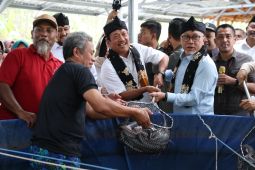
The model has been implemented at the Kamolan Red and White Village Cooperative in Blora District, Central Java, which supplies cleaned catfish to four SPPGs as a protein source for the national school meals programme.
Related news: Indonesia targets 30,000 village cooperatives to boost rural economy
According to him, the integration creates a village-based economic ecosystem by connecting production, cooperative business management, and sustainable procurement by SPPGs from upstream to downstream.
He reviewed the programme at the cooperative’s biofloc aquaculture facility alongside the minister of Villages and Development of Disadvantaged Regions, minister of Marine Affairs and Fisheries, members of the House of Representatives, and Blora district head.
The Kamolan cooperative supplies cleaned catfish to four SPPGs at Rp25,000 per kilogram, of which each nutrition service unit ordering about 250 kilograms per delivery.
Hasan said the purchasing arrangement provides predictable demand, allowing fish farmers to plan production volumes and harvest schedules according to SPPG requirements.
The Kamolan biofloc farming unit began operating in February 2026 and produced about 1.04 metric tons of catfish during its first production cycle.
Related news: Prabowo marks first year with major public programs: Hartarto
During its second cycle, the facility completed a partial harvest of about 605 kilograms. Currently, 22 of its 24 ponds are stocked with approximately 92,000 catfish fingerlings.
The fingerlings are stocked in stages to align harvest schedules with the supply requirements of the four SPPGs, ensuring continuous deliveries for the nutrition programme.
Stronger links between community production, cooperative management, and SPPG procurement, he added, could stimulate village economies while supporting the supply of nutritious food.
“KDMP’s integration with the Free Nutritious Meals programme proves that government programmes are now connected from upstream to downstream. Community production is absorbed, village economies grow, and the benefits return to the public through nutritious food while strengthening national food security,” he said.
Related news: Government targets fishermen’s exchange rate at 120: Minister
The government expects the integration to strengthen cooperatives as productive business managers while expanding sustainable market access for local producers.
Nationally, Indonesia targets 7.15 million metric tons of aquaculture production in 2026.
In supporting the goal, the government is expanding its thematic biofloc aquaculture programme to increase fish production, create jobs, strengthen village economies, and supply protein for the MBG programme.
Related news: Indonesia’s Waingapu shrimp estate to create 7,000 jobs: Minister
Translator: Aria Ananda, Martha Herlinawati Simanjuntak
Editor: Fransiska Ninditya
Copyright © ANTARA 2026