


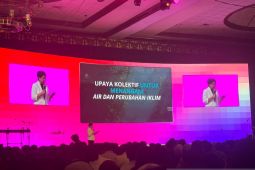
Jakarta (ANTARA) – UN Secretary-General Special Envoy for Water Retno Marsudi warned that climate change serves as a “threat multiplier” that significantly escalates global challenges surrounding water security.
Speaking at the Indonesia Net Zero Summit (INZS) 2026 in Jakarta on Saturday, the former Indonesian foreign minister stated that water access is no longer merely a technical or sectoral issue, but an urgent political and comprehensive development challenge.
“Climate change is a threat multiplier that can exacerbate all challenges faced in water issues,” Retno stated, calling for immediate political momentum and structural acceleration.
She explained that addressing the crisis requires immediate acceleration toward achieving Sustainable Development Goal (SDG) 6, which aims to ensure clean water and adequate sanitation for all.
According to Retno, to achieve the SDG 6 targets by the 2030 deadline, Indonesia must drastically increase its current rate of progress—requiring an eightfold acceleration in safe drinking water management, a sixfold increase in safe sanitation, and a twofold increase in basic hygiene services.
“If we do not do this, SDG 6 targets will only be achieved in 2049,” Retno cautioned.
To overcome these hurdles, she urged multi-stakeholder collaboration across government, civil society, and the private sector.
She highlighted a significant funding imbalance in the water and sanitation sector, where public budgets currently account for 86 percent of financing, while private sector participation remains at just 2 percent.
During the summit, Retno outlined a staggering picture of global water stress, noting that more than 2.2 billion people—one in four globally—currently lack access to safe drinking water.
Related news: Indonesia, Australia collaborate on innovative water resilience tool
Furthermore, 3.5 billion people lack adequate sanitation, while roughly 4 billion face severe water scarcity. Over the past decade alone, available renewable freshwater per capita has dropped by approximately seven percent.
Looking ahead to 2050, when the global population is projected to reach 9.7 billion, water demands are expected to grow by more than 25 percent, alongside a 50 percent increase in food requirements.
Retno noted that 72 percent of additional freshwater is utilized by agriculture, placing food security, health, and economic stability at risk.
She further cautioned that technological expansion, including artificial intelligence and digital transformation, is compounding the crisis.
Emerging digital infrastructure is projected to drive regional water demands up by as much as 129 percent, with 40 percent of global data centers currently operating in areas experiencing severe water stress.
Retno concluded that integrating water management into broader climate action and net-zero emission frameworks remains essential to securing sustainable development.
Related news: Climate mitigation supports survival of archipelagic countries: Retno
Translator: Cindy Frishanti Octavia, Yashinta Difa
Editor: Rahmad Nasution
Copyright © ANTARA 2026