


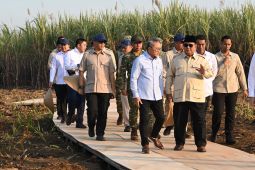
Jakarta (ANTARA) – Indonesia has achieved self-sufficiency in eight food commodities and improved farmers’ purchasing power during the first two years of President Prabowo Subianto’s administration, Coordinating Minister for Food Affairs Zulkifli Hasan said.
He attributed the progress to efforts to increase domestic food production, supported by measures to protect agricultural prices, improve access to subsidized fertilizers, and strengthen rural economies.
“Thank God, our efforts to strengthen food sovereignty are beginning to bear fruit. We are grateful that Indonesia is increasingly able to meet its domestic food needs,” he said in an official statement received in Jakarta on Thursday.
The eight commodities are rice, corn, consumer sugar, bird’s eye chilies, large red chilies, eggs, chicken meat, and shallots.
Zulkifli added that the government had stopped importing rice for domestic consumption, citing improvements in national production capacity.
The state logistics agency Bulog manages government rice reserves to help maintain domestic supplies. Bulog President Director Ahmad Rizal Ramdhani reported on October 20, 2026, that government rice stocks stood at approximately 4.55 million metric tons.
On farmers’ welfare, Statistics Indonesia (BPS) recorded the national Farmer Exchange Rate (NTP) at 131.11 in September 2026, up from 120.30 in September 2024.
The NTP measures the ratio of prices received by farmers to the prices they pay for household consumption and agricultural production inputs. A higher NTP indicates stronger purchasing power among farmers, although it does not directly measure their overall income.
To help protect farmers from falling prices during harvests, the government set the government purchasing price (HPP) for dry-harvested paddy at Rp6,500 (US$0.36) per kilogram at the farm gate.
For corn ready for harvest with a moisture content of 18–20 percent, the government set the purchasing price at Rp5,500 per kilogram.
The government has also streamlined the distribution of subsidized fertilizers and reduced their highest retail prices (HET) by 20 percent, effective October 22, 2025.
The price of urea fertilizer fell from Rp2,250 to Rp1,800 per kilogram, while the price of NPK fertilizer decreased from Rp2,300 to Rp1,840 per kilogram.
According to Ministry of Agriculture data, the number of farmers redeeming subsidized fertilizers through July 2026 increased by an average of 7 percent compared with the same period in the previous year.
Zulkifli emphasized that higher food production must translate into tangible benefits for people working in agriculture and fisheries.
“These achievements must be felt by farmers, fishers, and communities whose voices are often unheard in the food supply chain. This is the mandate we must safeguard together,” he said.
To further strengthen national food security, the government has also launched the Red and White Village Cooperatives and Red and White Fishing Villages programs.
Related news: Prabowo cites food self-sufficiency as key government achievement
Related news: Indonesia’s roadmap targets young farmers to strengthen food security
Translator: Aria Ananda, Raka Adji
Editor: Primayanti
Copyright © ANTARA 2026