


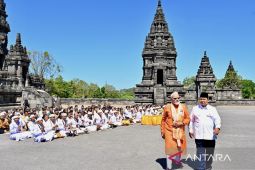
Jakarta (ANTARA) – Indonesia’s Ministry of Culture is accelerating efforts to restore and revitalise Prambanan Temple area in Yogyakarta to preserve its heritage and benefit the community.
“This step was taken to preserve the monumental cultural heritage, a 9th-century AD legacy, intact, while also establishing it as a cultural center and living heritage benefiting the community,” the Minister of Culture Fadli Zon remarked in a statement on Wednesday.
Prambanan Temple is the largest Hindu temple area in Indonesia, located in the administrative area of Bokoharjo Village, Prambanan Sub-district, Sleman District, Yogyakarta Special Region.
According to Fadli, the restoration of the ancillary temples surrounding the three main temples, namely the Shiva, Brahma, and Vishnu temples, in the Prambanan Temple area still faces technical challenges.
Related news: Modi’s visit marks new era for Indonesia-India strategic partnership
The biggest technical challenge in restoring the temple is the availability of original stones at the site, where some of the temple’s building stones are estimated to have dispersed, leaving between 10 and 30 percent of the original material at each point of the temple.
The condition of the remaining stones also varies, with some are still intact, others are broken, and some have experienced degradation and weathering due to salting and the influence of micro-environmental factors.
“We are discussing a major restoration of Prambanan Temple, which will involve experts from various fields to ensure the temple can be fully restored,” he noted.
Currently, his office is finalising a comprehensive study on the restoration of the Prambanan Temple area, involving experts in conservation, archaeology, and structural engineering.
The government is also open to international cooperation in the restoration and revitalisation of the Prambanan Temple area.
Related news: Prambanan set to become global Hindu spiritual hub: ministry
Earlier, the Indian government has conveyed commitment in supporting the restoration of one quadrant or one-quarter of the area of the ancillary temples within the temple area.
In accordance with restoration guidelines established by the United Nations Educational, Scientific, and Cultural Organization (UNESCO), three-quarters of the temple’s area will be independently restored by a team of Indonesian national experts.
Fadli said the temple’s comprehensive restoration goes beyond rebuilding the structure, but also seeking to revitalise a tourism ecosystem rooted in culture, history, and religion for sustainable community benefits.
“We hope this will attract more cultural, historical, and religious tourists from various countries, both foreign and domestic,” he added.
In addition to restoring and revitalising the Prambanan Temple area, the government is also planning the restoration of Sewu Temple, the second largest Buddhist temple complex after Borobudur Temple.
Sewu Temple is located in Bugisan Village, Prambanan Sub-district, Klaten District, Central Java Province.
Related news: Prambanan as India-Indonesia tourism bridge: Minister
Translator: Sinta Ambarwati, Resinta Sulistiyandari
Editor: Fransiska Ninditya
Copyright © ANTARA 2026