


Jakarta (ANTARA) – Indonesia is seeking to tap the international compliance carbon market under Article 6 of the Paris Agreement to maximize the carbon potential of its forestry sector and nature-based solutions (NbS).
Director General of Sustainable Forest Management at the Ministry of Forestry Laksmi Wijayanti said opportunities were expanding, driven by demand from Singapore, Japan, and the international aviation scheme ICAO-CORSIA.
In a statement issued in Jakarta on Saturday, she said the international carbon market requires high-quality credits with guaranteed integrity, including measures to prevent double counting and ensure transparency in carbon accounting.
“The forest carbon transaction pathway through Article 6 requires clear governance, credible accounting, environmental and social safeguards, transparent record-keeping, and commercially viable schemes for investors and buyers,” she said.
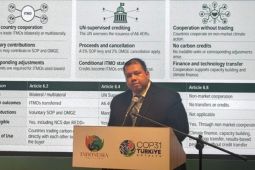
Speaking at the opening of a panel session titled “High-Integrity Forest Carbon: Indonesia’s Pathway under Article 6” at the Indonesia Pavilion during COP31 in Antalya on Friday (November 13, 2026), she said Indonesia’s forest carbon potential stood at 13.4 gigatons of CO2, based on 2025 BloombergNEF data.
Director of Forest Utilization Business Development at the Ministry of Forestry Ilham presented strategies for optimizing forest utilization businesses through carbon credit sales under the market-based mechanisms (Articles 6.2 and 6.4) and the non-market mechanism (Article 6.8) of the Paris Agreement.
According to Ilham, demand for NbS carbon credits under the Article 6.2 mechanism was substantial and urgent, particularly from Singapore, Japan through the Joint Crediting Mechanism (JCM), and the ICAO-CORSIA scheme.
“Currently, Singapore allows the use of international carbon credits to offset a maximum of 5 percent of companies’ taxable emissions,” he said.
Meanwhile, Japan, through the JCM, has set a cumulative international mitigation target of around 100 million tons of CO2 by 2030 across all partner countries.
Indonesia is actively exploring JCM cooperation with Japan, with peatlands and mangroves serving as important areas for opening access to the Japanese market. These ecosystems distinguish Indonesia from Japan’s other partner countries.
Another opportunity, he said, comes from ICAO-CORSIA, which is estimated to require 200 million to 250 million eligible carbon units by January 2028.
The government has prepared a regulatory framework for carbon trading through Presidential Regulation No. 110 of 2025 and Forestry Ministerial Regulation No. 6 of 2026. The framework includes provisions on authorizing international transfers of mitigation outcomes (ITMOs) and technical arrangements for carbon trading in the forestry sector.
“Indonesia has prepared regulations to support carbon trading under Article 6 of the Paris Agreement, including provisions on authorizing the transfer of mitigation outcomes and preventing double counting,” Ilham said.
Verra’s Regional Representative for Asia Pacific, Win Sim Tan, said the use of existing methodologies could accelerate carbon project development, as the government would not need to develop new methodologies from scratch.
She cited several Verra methodologies already accepted by Singapore, including those covering REDD+, afforestation, and forest protection.
Meanwhile, International Emissions Trading Association (IETA) International Policy Director Andrea Bonzanni said Indonesia also needed to engage actively in technical discussions on the Article 6.4 mechanism during the ongoing UNFCCC negotiations at COP31.
He noted that issues concerning permanence, standard methodologies, and tools had yet to adequately accommodate the forestry sector in the draft CMA discussions on Article 6 of the Paris Agreement.
Bonzanni also reminded the government of the need to balance international carbon credit transfers with the achievement of Indonesia’s national climate targets, known as nationally determined contributions (NDCs).
On the market demand side, Emergent CEO Eron Bloomgarden said forested countries needed certainty about long-term demand to ensure a reliable supply of carbon credits, while buyers also needed certainty about supply.
Related news: Indonesia seeks wider community share in forest carbon trade
Related news: Indonesia to pioneer trial of G20-backed carbon credit data model
Translator: Subagyo, Fauzul Azhim Bin Fakhrurazi
Editor: Primayanti
Copyright © ANTARA 2026