


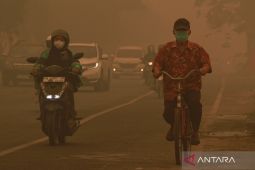
Jakarta (ANTARA) – The University of Indonesia’s Faculty of Medicine, through its Indonesian Medical Education and Research Institute (IMERI), has urged stronger fire prevention and health monitoring to protect children and other at-risk groups from smoke exposure.
According to a press statement received here Saturday, the faculty’s dean, Anna Rozaliyani, said human health must be central to efforts to protect the environment and address forest and land fires.
“Forest and land fires are not just about smoke. They threaten health, safety and future generations. Preventing exposure, identifying risks early and providing follow-up must be grounded in science and cross-disciplinary cooperation,” she said.
IMERI Director Bernie Endyarni Medise said protecting children from the health effects of forest-fire smoke requires sustained action, not just emergency measures when haze becomes severe.
A multidisciplinary approach is needed because smoke exposure affects people differently depending on individual characteristics, health conditions, exposure levels and environmental factors.
People at increased risk, including children, older adults, people with chronic illnesses and exposed workers, need protection tailored to their risk levels.
Pediatric respiratory specialist Nastiti Kaswandani of the Indonesian Pediatric Society and the University of Indonesia said smoke exposure can cause more than acute respiratory problems.
Children chronically exposed to smoke may face lasting impairment of lung development and higher risks of persistent asthma, chronic obstructive pulmonary disease (COPD), stunted growth and cognitive problems.
Children are especially vulnerable because their lungs are still developing and their narrower airways make it easier for mucus and particles to build up and cause blockages, Nastiti said.
Children also breathe faster than adults, inhaling more air per kilogram of body weight.
They also spend more time active outdoors, while their nasal passages are less effective at filtering particles, increasing the amount that reaches their lungs.
Their immune systems are also immature, and their bodies’ detoxification systems are still developing.
Fine particulate matter (PM2.5), about 30 times smaller than a human hair’s diameter, can travel through the upper airways to the lungs’ air sacs and, in some cases, enter the bloodstream.
Acute effects include respiratory infections, more frequent or severe asthma attacks, eye irritation and loss of appetite.
More concerning are the long-term effects of chronic exposure, impaired lung development in childhood can have lifelong consequences, Nastiti said.
Research on Indonesia’s 1997 fires found that children exposed in utero were shorter than unexposed peers at ages 10 and 17. Nastiti also cited possible effects on IQ, behavior and memory.
Nastiti outlined four preventive steps, starting with regular checks of children’s height and weight and monitoring for developmental delays.
The second is to monitor breathing, watch for recurring coughs or wheezing, assess asthma control and conduct spirometry or lung-function tests where available.
Third, strengthen prevention through up-to-date vaccinations, good nutrition, smoke-free homes and healthy living practices.
Fourth, advocate for healthier environments by monitoring air quality, providing clean-air spaces in schools and preventing forest and land fires, Nastiti said.
Related news: Indonesia sets up 477 emergency oxygen shelters amid wildfire haze
Related news: Health Ministry monitors ARI cases amid forest fire haze
Translator: Sinta A, Rahmad Nasution
Editor: Primayanti
Copyright © ANTARA 2026